
 Cockroaches
 Rats
Rats Mice
Mice Bed Bugs
 Ants
Ants Wasps
Wasps Spiders
 Field Mice
Carpenter ants: how to recognize the signs of an infestation
How can you tell if you have carpenter ants?
Carpenter ants are hard to spot, because they work hidden inside wood. Four signs of a carpenter ant infestation should put you on alert:
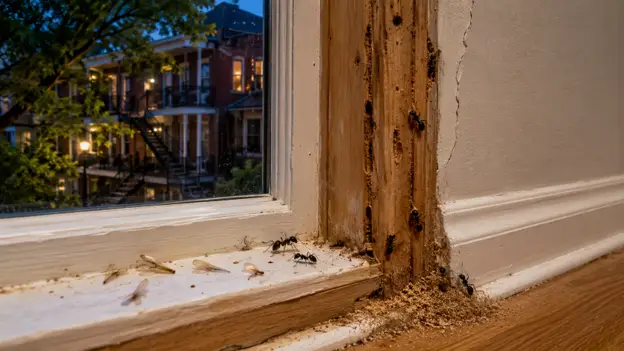
- small piles of wood sawdust (called frass) at the base of walls or under frames,
- scratching noises inside the walls, especially at night,
- discarded wings near windows after a swarm,
- large black ants moving through the house, especially in the evening.
If several of these clues add up, a colony is probably active inside your structure. Unlike ordinary ants, which are mostly drawn to food, carpenter ants settle into the very wood of your home, which makes them more concerning. The good news: caught early, carpenter ants can be treated effectively, before they weaken the wood. An exterminator in Montreal can confirm the situation quickly, often on the very first inspection.
Carpenter ants will not destroy a house in a few weeks, but a colony left ignored can weaken a wood frame for good.
Recognizing a carpenter ant
Before looking for the signs, you need to know how to identify the insect itself. A carpenter ant does not look quite like the small garden or pavement ants you come across outside, and that distinction matters. A correct identification guides everything else: the right diagnosis leads to the right treatment, targeted at the right species.
What a carpenter ant looks like (size, colour)
The carpenter ant stands out first by its size. Workers measure 6 to 13 mm, much larger than ordinary pavement ants, and the queen can reach 2.5 cm. Its colour ranges from black to dark brown, sometimes with reddish tones on the thorax. In Canada, the black carpenter ant is the most widespread, followed by the red carpenter ant in the east.
They get into the house through foundation cracks, tree branches touching the roof, or firewood brought indoors. Inside, they are drawn to sweet and protein-rich foods, which often leads them toward kitchens and bathrooms.
Like all ants, it has a narrow waist, with a slim pedicel between the thorax and the abdomen, and elbowed antennae. Unlike other species, carpenter ants can bite to defend themselves: our article on ant bites explains when that happens. To understand how a colony grows over time, also read our guide on the life cycle of ants.
Carpenter ant or termite? The table that clears up the confusion
The most common mix-up is between the carpenter ant and the termite. Both attack wood, but in radically different ways: the carpenter ant hollows out wood to house its colony, while the termite eats it. That detail changes the whole way you spot an infestation, because the carpenter ant leaves behind debris that the termite does not produce. Telling them apart avoids two costly mistakes: panicking for nothing, or underestimating a real structural problem.
| Criterion | Carpenter ant | Termite |
| Relationship to wood | Hollows it out (does not eat it) | Eats it (wood-feeding) |
| Body shape | Narrow, with a pedicel | Broad, with no defined waist |
| Antennae | Elbowed | Straight |
| Wings | Front pair longer | All the same length |
| Debris | Visible fine sawdust | Little to no sawdust |
The signs of a carpenter ant infestation
Let’s move on to the concrete clues that give away an established colony. None of them is decisive on its own, but together they leave little doubt. Here are the three most reliable signs to watch closely.
Wood sawdust (frass) at the base of walls
The most reliable sign is the presence of frass: a fine sawdust that looks like wood dust or pencil shavings. Because the carpenter ant does not digest wood, it has to push the debris out of its galleries, and it piles up at the base of walls, on window sills or in dark corners.
A simple test settles the question: clean up the small pile of sawdust. If it builds back quickly, activity is intense right above it, and a gallery is probably being dug inside the wall. Frass also often contains fragments of dead insects, which sets it apart from ordinary dust. The bigger the pile and the faster it comes back, the larger and more active the colony is just behind the wall.
Night-time noises in the walls
In the quiet of the night, you might hear a faint rustling, scratching or crackling inside the walls, the beams or the attic. Those are the workers digging and moving through their galleries, more active once evening comes.
These noises help you roughly locate the infested area behind a wall. Many homeowners describe the sound of small creatures in the wall before they have even seen a single ant. A hollow sound when you tap on woodwork that used to be solid is another telltale clue of a gallery.
Winged ants and swarming
In spring, a mature colony releases winged reproductive ants: this is swarming. Seen outdoors, in the yard or near a stump, these winged ants are perfectly normal and do not necessarily point to an infestation inside your home.
Winged ants indoors, on the other hand, especially in winter, are a strong signal. In Montreal, the warmth of indoor heating can fool the colony and trigger a winter swarm: that almost always means the main nest is inside the very structure of your home. Acting quickly then becomes clearly advisable.
These reproductives leave the nest to found new colonies, which explains why an infestation can spread to other areas of the house if you let it settle in.
Not sure? Get an inspection from a certified exterminator
Describing your clues to an expert takes two minutes. Our certified exterminators answer 24/7 across Greater Montreal and will tell you whether you need to act now.
Call now: 514-501-2076
Where the nest hides: main nest and satellite nests
Killing a few visible ants solves nothing: you have to reach the nest. Carpenter ants often work with a main nest, sometimes located outdoors (a stump, a woodpile, a damp area), connected to satellite nests set up in the walls, the beams or the attic of the house. A single colony can therefore occupy several places at once, which explains why partial treatment fails so often.
Damp wood, walls and framing: the at-risk areas
Carpenter ants look for damp, weakened or decaying wood, which is far easier to dig through than sound, dry wood. Some areas of the house are therefore particularly exposed:
- window and door frames affected by water infiltration,
- beams and framing near a past water damage event,
- the area around bathtubs, sinks and leaking roofs,
- wood in contact with the ground, such as decks and patios.
Pinpointing satellite nests often takes an expert eye, since they stay invisible behind the walls. In Montreal, damp basements and crawl spaces are frequent hot spots.
On the prevention side, a few habits reduce the risk: fix leaks and moisture problems, seal cracks, keep firewood away from the house and trim branches that touch the roof. This is where technology makes all the difference between a hit-or-miss treatment and a targeted intervention.
Our thermal camera locates the nest inside your walls
Is the nest hidden? Our thermal camera finds it without tearing down your walls. A precise inspection targets the treatment where the colony actually is.
See our carpenter ant treatment
Is it urgent? Why you should act fast against carpenter ants
Carpenter ants do not cause a sudden collapse, but their work is slow, quiet and cumulative. The longer a colony stays active, the more the damage adds up, and the higher the repair bill eventually climbs.
Structural damage that gets worse over time
A colony generally takes 3 to 6 years to become truly destructive, reaching several thousand individuals by then. During those years, the galleries weaken the wood structure from the inside, often with no visible outward sign. In time, the structural damage can reach load-bearing beams and the framing itself.
In advanced cases, repairs sometimes run into the thousands of dollars, far more than the cost of the treatment itself. An annual inspection is a good habit for wood-frame homes, especially after water damage.
That is why early detection protects your safety as much as your wallet. Carpenter ants mainly hit houses, and our residential extermination service handles these cases every day. Once the work is done, our guide on what to do after ant treatment helps you avoid a reinfestation.
Why professional treatment is a must in Montreal
Do-it-yourself solutions almost always fail against carpenter ants, because a surface product never reaches the hidden nest. A truly effective treatment follows a precise logic:
- Identify the species and confirm the infestation.
- Locate the main nest and the satellite nests.
- Treat the colony directly, not just the visible ants.
- Provide follow-up to verify complete eradication.
That is exactly the approach of a certified ant exterminator, using products approved by Health Canada and a written guarantee on the invoice. A good professional diagnosis also identifies the conditions that attracted the colony, such as excess moisture, so it does not come back. Before hiring anyone, this advice on how to choose the best ant exterminator is worth reading. An annual preventive follow-up then sharply reduces the risk of a return.
Against carpenter ants, a store-bought spray kills a few workers, never the colony eating away at your walls.
Request a free quote
No hidden fees, no commitment. Get a clear picture of the treatment, the price and the guarantee before any work begins.
Certified exterminators in Montreal for over 30 years. Written warranty on the invoice, thermal camera included, Health Canada-approved products.